

Canada vs. U.S. Real Estate Syndication: Key Differences
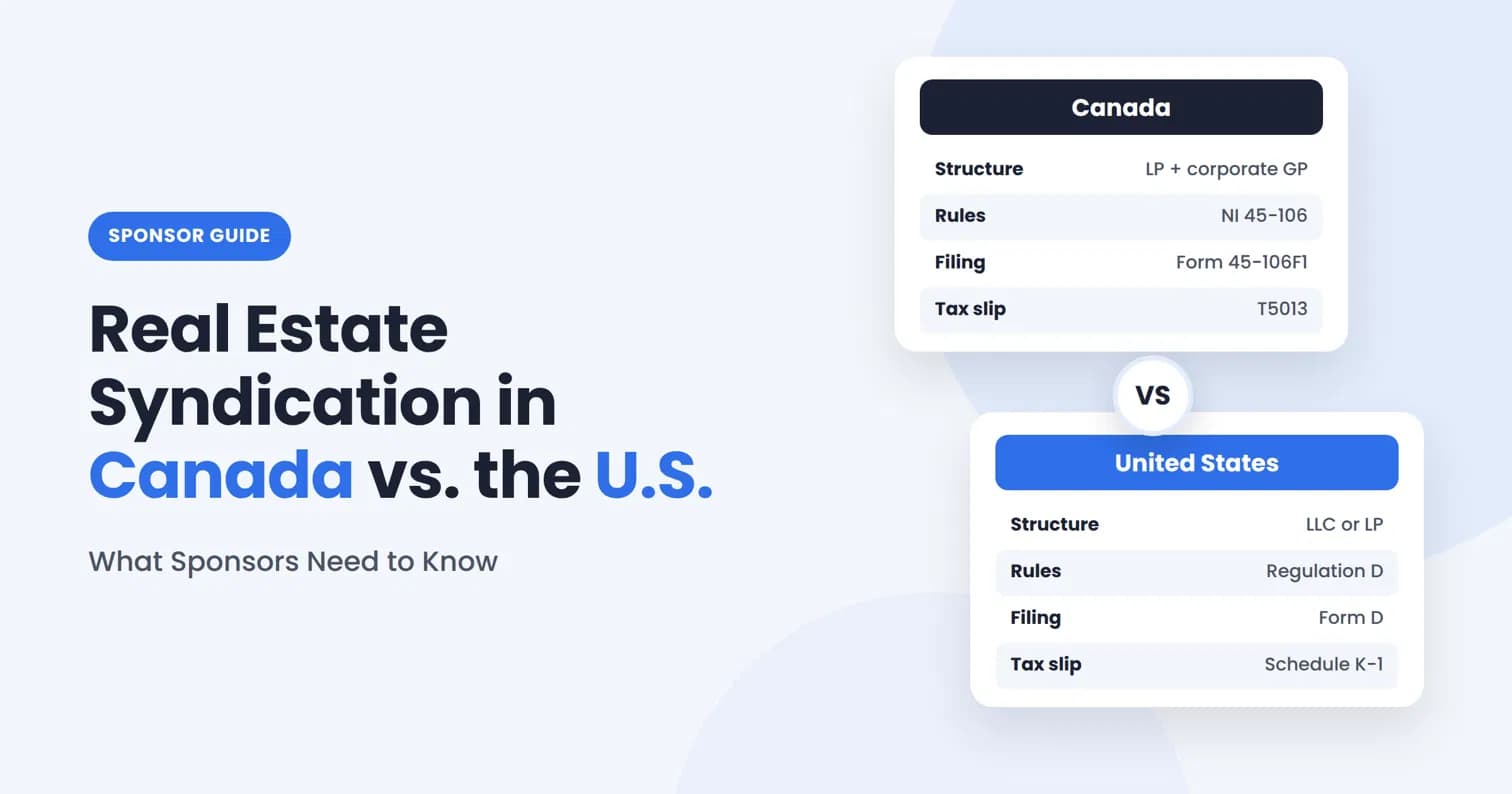
Real estate syndication works on the same basic idea in Canada and the United States: a sponsor (General partner) finds and manages a deal while outside investors (Limited Partners) contribute capital.
But the legal framework behind that raise can look very different across these two countries.
In the U.S., syndicators often look at Regulation D, Rule 506(b), Rule 506(c), LLCs, Form D and accredited investors. In Canada, sponsors are more likely to encounter limited partnerships, National Instrument 45-106, prospectus exemptions, Form 45-106F1 and provincial securities regulators.
Those differences change who can invest, how a deal can be marketed, which documents are needed and what must be filed after capital comes in.
This guide explains the major differences from a sponsor’s perspective.
This article is educational only and does not constitute legal, securities, tax or investment advice. Private offerings are highly fact-specific. Sponsors should work with qualified securities and tax counsel in the jurisdictions where they raise capital.
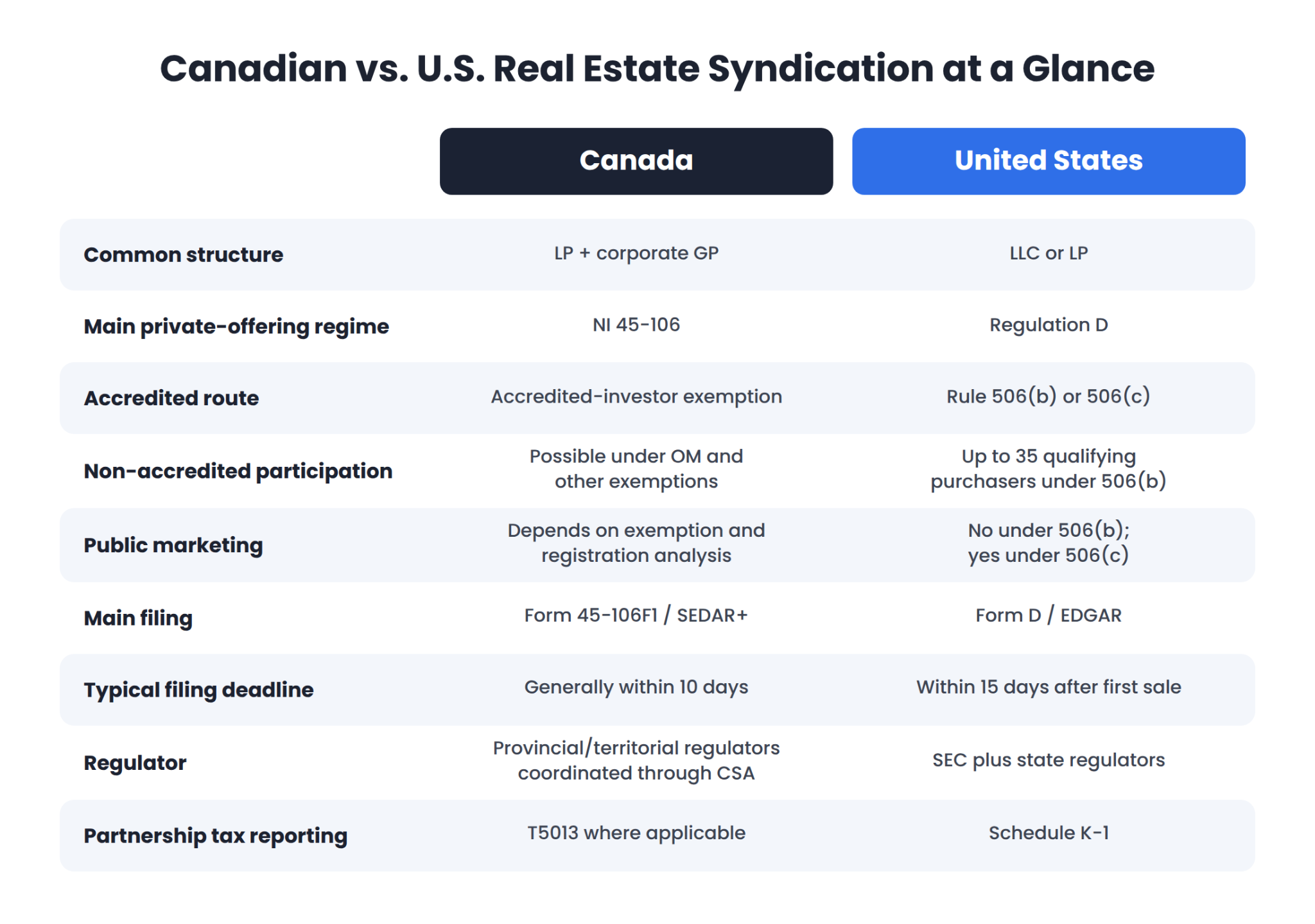 The concepts are similar, but there is no exact Canadian equivalent to a 506(b) or 506(c) syndication.
Canada does not have one national securities regulator
The U.S. system starts with federal securities law and the Securities and Exchange Commission. Regulation D provides several exemptions from registration, including Rules 506(b) and 506(c).
Canada is different.
Securities regulation is primarily provincial and territorial. The Canadian Securities Administrators, or CSA, coordinate many rules nationally, which is why sponsors across Canada encounter National Instrument 45-106 Prospectus Exemptions.
At the same time, exemptions, filing requirements and registration issues can still vary by jurisdiction.
The current NI 45-106 framework includes exemptions such as the accredited-investor exemption and the offering memorandum exemption. BC Securities Commission
For a Canadian sponsor, the question is therefore not simply:
“Am I doing a 506(b) or 506(c)?”
It is closer to:
“Which prospectus exemption am I relying on, and what rules apply where my investors are located?”
Deal structure: LLCs in the U.S., LPs in Canada
A typical U.S. syndication may use an LLC that owns the property, with passive investors purchasing membership interests while the sponsor controls the manager or managing-member entity.
That is also the structure usually used: the sponsor manages a property LLC while passive investors provide equity. Canada does not have a domestic LLC equivalent.
For larger Canadian real estate investments, a limited partnership is common.
A simplified Canadian syndication structure often has investors contributing capital to a limited partnership that owns the property, while a corporate general partner manages the limited partnership on the investors’ behalf.
Limited partners generally contribute capital and participate economically without running day-to-day operations. The corporate GP manages the partnership and helps isolate GP-level liability from the sponsor personally.
The economics can still look very familiar to a U.S. sponsor. Canadian partnership agreements may include:
- preferred returns;
- return-of-capital tiers;
- promotes;
- IRR hurdles;
- waterfalls;
- acquisition fees; and
- asset-management fees.
In other words, the way the syndication is structured changes more than the underlying real estate economics.
Limited-partnership governance also needs care. Investor approval rights over major decisions are common, but the boundaries between passive rights and participation in control depend on the applicable provincial partnership statute. Those provisions should be reviewed by counsel.
If you need a refresher on the economics behind these structures, see Cash Flow Portal’s guide to real estate return metrics for multifamily syndicators.
Accredited investors exist in both countries, but the definitions differ
Both countries allow private issuers to raise money from investors that meet an accredited-investor definition.
In the U.S., Rule 501(a) defines accredited investors through tests including net worth, income and certain professional qualifications.
Canada also has an accredited-investor exemption under section 2.3 of NI 45-106.
For individuals, common Canadian qualification routes include thresholds based on:
- financial assets;
- individual income;
- combined income with a spouse; or
- net assets.
The important point is that the Canadian tests are not identical to the U.S. tests.
For example, the Canadian financial-assets test is conceptually different from the U.S. net-worth test. Sponsors should not assume someone who qualifies as accredited in one country automatically qualifies in the other.
The U.S. definition may also continue evolving. The SEC has scheduled a September 30, 2026 open meeting to consider whether additional certifications, designations or credentials should qualify individuals for accredited-investor status. As of September 25, the existing Rule 501 framework remains in force. SEC
Canada does not simply have a 506(b) equivalent
Under Rule 506(b), a U.S. issuer may sell to an unlimited number of accredited investors and up to 35 qualifying non-accredited purchasers, subject to the rule’s requirements. General solicitation is prohibited.
Canada does not use that same framework.
A Canadian investor who is not accredited may still be able to participate under another prospectus exemption.
One important example is the offering memorandum exemption under section 2.9 of NI 45-106.
Depending on the jurisdiction and investor category, investment limits and risk-acknowledgement requirements may apply.
Ontario also now has a self-certified investor exemption. Ontario Instrument 45-510, effective October 25, 2025, allows certain investors who do not meet the traditional accredited-investor financial tests to qualify based on specified education, experience, credentials or investment knowledge, subject to its conditions. OSC Innovation
This is not yet one uniform Canada-wide regime.
Most CSA members proposed Multilateral Instrument 45-111 in 2025 to harmonize self-certified investor exemptions across participating jurisdictions. The CSA’s 2025–26 year in review still describes MI 45-111 as a rule-making project. Alberta Securities Commission
The practical takeaway is simple:
“Not accredited” does not automatically mean “cannot invest.” The sponsor still needs an exemption that actually applies to that investor.
Offering memorandum vs. private placement memorandum
U.S. syndicators are accustomed to the private placement memorandum, or PPM.
The PPM is a detailed document setting out the offering, investment terms and risks.
Canadian sponsors may instead encounter an offering memorandum, or OM.
The terms sound similar, but they should not be treated as legally interchangeable.
When a Canadian issuer relies specifically on the OM exemption, prescribed disclosure requirements can apply.
For real estate issuers, there is an additional layer.
Since 2023, issuers engaged in real estate activities that prepare a Form 45-106F2 OM must include Schedule 1 — Additional Disclosure Requirements for an Issuer Engaged in Real Estate Activities. That can require property-specific information about real estate already owned or expected to be acquired. OSC
An independent appraisal may also be required in specified circumstances, including certain related-party acquisitions and cases where a value for real property is disclosed in the OM. OSC
That makes the OM exemption especially important for real estate sponsors: it can create a more prescriptive disclosure process tied directly to the underlying properties.
But an OM is not required every time a Canadian sponsor raises private capital.
If another exemption applies, such as the accredited-investor exemption, the offering may use subscription and disclosure documents prepared by counsel without relying on the formal OM exemption.
Private placement does not necessarily mean OM exemption.
The OM exemption can also create ongoing obligations
The work does not necessarily end after closing.
In jurisdictions including Ontario, certain non-reporting issuers using the OM exemption must provide audited annual financial statements within 120 days after year-end. OSC
So choosing the OM exemption can affect not only who can invest, but also:
- ongoing financial reporting;
- regulatory filings;
- use-of-proceeds reporting; and
- the long-term compliance workload of the issuer.
Those costs should be considered alongside access to a broader investor pool.
Marketing: 506(b) and 506(c) give U.S. sponsors a cleaner split
This is one of the clearest differences.
Under Rule 506(b), general solicitation and advertising are prohibited.
Under Rule 506(c), an issuer may generally advertise the offering, but every purchaser must be accredited and the issuer must take reasonable steps to verify accredited status.
That verification process became more flexible in 2025.
In March 2025, SEC staff stated in a no-action letter that a sufficiently high minimum investment, combined with specified purchaser representations and other conditions, could support a conclusion that reasonable verification steps had been taken.
The fact pattern used minimum investments of US$200,000 for individuals and US$1 million for legal entities. SEC
That does not create an automatic safe harbor. The SEC staff emphasized that verification remains a facts-and-circumstances determination and that the letter itself does not change the law. SEC
For sponsors, the practical point is:
506(c) still requires verification, but that does not necessarily mean collecting the same financial documents from every investor.
Canada does not offer the same clean 506(b)-versus-506(c) split.
A Canadian sponsor needs to consider:
- the prospectus exemption being relied on;
- where each purchaser resides;
- how the opportunity is marketed; and
- whether the sponsor or another participant is triggering dealer-registration requirements.
Dealer registration is a separate Canadian question
This is one of the most important Canadian distinctions.
A prospectus exemption answers whether securities can be distributed without a prospectus.
It does not automatically answer whether the person selling those securities can do so without registration.
Canadian securities regulators apply a business-trigger analysis to determine whether a person or firm is in the business of trading securities.
For a sponsor, registration risk can become more important where:
- capital raising happens repeatedly;
- investors are actively solicited;
- third-party capital raisers are involved;
- transaction-based compensation is paid; or
- someone is acting as an intermediary between the issuer and investors.
Where registration is required in the exempt market, an exempt market dealer, or EMD, may become relevant.
This is an area where sponsors should involve Canadian securities counsel early rather than assuming that having a valid investor exemption resolves every securities-law issue.
Filing and subscription workflows differ
U.S. Regulation D issuers generally file Form D with the SEC within 15 days after the first sale.
Canada generally uses Form 45-106F1, Report of Exempt Distribution, for many common prospectus exemptions.
A typical non-investment-fund issuer must file the report through SEDAR+ within 10 days after the distribution. BC Securities Commission
If the OM exemption is used, the offering memorandum is generally filed at the same time as the Form 45-106F1. BC Securities Commission
So in the United States, after the investment closes, the issuer generally files Form D with the SEC through EDGAR. In Canada, the issuer generally files Form 45-106F1 with the applicable provincial or territorial securities regulators through SEDAR+.
The subscription packages also differ.
A U.S. offering commonly includes:
- PPM;
- LLC operating agreement;
- subscription agreement;
- investor questionnaire; and
- accreditation documentation.
A Canadian LP offering may instead involve:
- limited partnership agreement;
- subscription agreement;
- investor representations;
- exemption or accredited-investor certificates;
- applicable risk acknowledgements; and
- an OM where the OM exemption is used.
The specific forms change, but the operational problem is the same: sponsors need the right documents, signatures and investor qualification information tied to the right deal.
Private securities can also be difficult to resell
Illiquidity is not only about the property.
Canadian securities sold under a prospectus exemption can be subject to resale restrictions under NI 45-102.
For private, non-reporting issuers, investors should not assume their interests simply become freely tradeable after a short holding period.
A transfer may need to satisfy securities-law requirements in addition to any transfer restrictions contained in the limited partnership agreement.
That is a useful distinction for sponsors to communicate clearly:
the partnership agreement may permit a transfer while securities law still restricts it.
Sponsors distributing securities in Québec should also confirm the applicable French-language requirements for offering and disclosure documents with Québec counsel.
Tax reporting looks different, but the operational problem is familiar
U.S. real estate sponsors commonly deal with Schedule K-1s because partnerships and many LLCs taxed as partnerships pass taxable items through to their investors.
Canadian partnerships generally operate on a flow-through basis as well.
CRA explains that the partnership itself generally does not pay income tax on partnership income. Instead, partners report their share, and partnerships meeting the filing requirements submit a T5013 Partnership Information Return and provide T5013 slips to partners. Canada
At a high level, U.S. partnerships typically issue Schedule K-1s to investors, while Canadian partnerships generally use T5013 slips where required.
The tax rules are not interchangeable, but the sponsor-facing challenge is similar: keeping investor information accurate and delivering the right tax documents to the right people.
What actually stays the same?
After all those differences, the underlying job of a syndicator looks surprisingly similar.
A sponsor in either country still needs to:
- find and underwrite a property;
- determine the capital stack;
- raise equity;
- define sponsor and investor rights;
- structure distributions;
- manage the asset;
- report to investors;
- distribute cash; and
- eventually refinance or sell.
Preferred returns, promotes, waterfalls, IRR and equity multiples can exist on either side of the border.
The biggest differences are therefore not necessarily how the property makes money.
They are how the investment is structured, sold, documented and reported.
Canada vs. U.S. syndication: the practical takeaway
A U.S. syndicator entering Canada should not simply replace “SEC” with “OSC” and use the same playbook.
The concepts rhyme, but the frameworks are different.
U.S. sponsors frequently organize a private raise around 506(b) or 506(c).
Canadian sponsors instead need to determine how the deal is structured, which prospectus exemption applies, whether each investor qualifies, whether dealer registration is required, what disclosure documents are needed, and which provincial filings must be made.
And because Canadian securities regulation is provincial and territorial, the answer may vary depending on where investors live.
The operational challenge is still familiar: sponsors need one accurate system for investors, subscriptions, documents, commitments, distributions and reporting.
That is where investor-management software becomes useful regardless of which side of the border the deal sits on.
Raising on either side of the border? Cash Flow Portal’s capital-raising tools keep your offerings, investor documents, commitments and distributions in one place, so you can focus on the deal, not the paperwork. Look for more details here.
About the author

Zayd Shirzay
I’ve been interested in real estate since I was 16, have worked for a real estate developer, and am currently a second-year Urban Development student at Western University.
Related posts
5 Real Estate Return Metrics for Multifamily Syndicators
By Zayd Shirzay | 09/18/26 | Guides for syndicators
A deal can have a strong projected IRR and still distribute little cash for years. Another deal can pay steady distributions but create limited profit at sale. Neither number tells the whole story. For multifamily syndicators, real estate return metrics help answer different questions: Is the purchase price reasonable? What cash can investors receive during […]

AI for Capital Raisers
By Alex Field | 07/08/26 | Guides for syndicators
Most capital raisers already use Claude or ChatGPT every day. They draft investor emails with it, prep calls with it, think through a raise with it. The problem: the AI can’t see the data those questions are about. Ask it who your top investors are and it will guess. Cash Flow Portal’s new MCP server […]
Best CRM for Capital Raisers
By Alex Field | 07/01/26 | Guides for syndicators
Most CRMs were not built for raising capital. They were built to sell software, book demos, or run online stores. It shows the moment a syndicator tries to track accreditation, chase a half-finished investment, or move investor data by hand. Here’s what a CRM built for capital raisers looks like in practice. ▶ Watch the […]
Most popular posts
- AI for Capital Raisers07/08/26 | Guides for syndicators
- Best CRM for Capital Raisers07/01/26 | Guides for syndicators
 The 10 Hottest Cities to Invest in Real Estate Before 202507/20/22 | Announcements
 Bonus Depreciation for Real Estate Professionals09/09/21 | Passive investor guides
 Free tools to help you develop your real estate syndication blog in 202108/06/21 | Guides for syndicators
Categories


 Seattle, WA







Products
Capital raising
Why Cash Flow PortalEquity raising simplifiedFunds on Cash Flow PortalCo-sponsorsCustom brandingProperty management
BookkeepingBank syncQuickbooks integrationReportsOwner portalMaintenanceApplications & eSignTenant screeningCRMRent collectionTenant portalCommunicationFund admin
Fund administrationInstitutional fund administrationSPVsFund admin servicesIntegrated CPA servicesBanking
Integrated bankingLeads
New leadsAccounting
Accounting©2026 All rights reserved. Cash Flow Portal Inc.